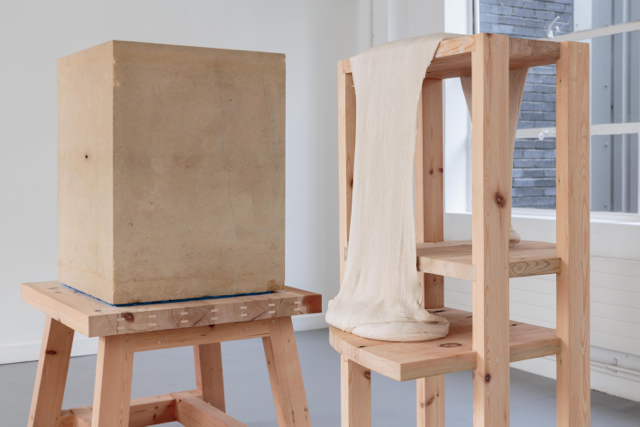
Photos: Tim Bowditch
Monday, 6 March 2017
Second set of images from Folds at SPACE
Here are a selection of images from the mid-point of my current exhibition Folds at SPACE, 13 January - 25 March. Over the duration of the show I am working with two stonemasons, Nancy Peskett and Lily Marsh to carve a piece of bath stone into the form of dough.
Photos: Tim Bowditch
Monday, 30 January 2017
First set of images from Folds at SPACE
Here are a selection of images from my current exhibition at SPACE, 13 January - 25 March.
Photos: Tim Bowditch
Friday, 13 January 2017
Contemporary Art Society: Artist to Watch
Really excited to have been featured by the Contemporary Art Society as their 'Artist to Watch'.
3 January 2017
By Ali MacGilp
In 2016 Laura Wilson (b. 1983 Belfast) undertook two important residencies: at Delfina Foundation, London as part of Markets and Movements, and the third season of the impressive Politics of Food
series and at Site Gallery, Sheffield. This has concentrated attention
on her latest long-term research-based project, which focuses on bread, a
prosaic, but metaphorically rich, foodstuff.
In her practice, Wilson frequently collaborates with specialists to create performative sculptural works that illuminate the relationship between materiality, memory and tacit or experiential knowledge. At Delfina Foundation she developed the project Trained on Veda, in which she sought to become the keeper of the century-old recipe of Northern Ireland’s malty Veda Bread. At Site Gallery she developed the intriguing performance Fold and Stretch (2016). Collaborating with a baker and a choreographer, she created a work that investigated the physicality of live dough and its relationship to the body through movement and dance.
Wilson’s upcoming solo show Folds at SPACE in Hackney’s Mare Street is the culmination of her recent residency-based research. Wilson stages a life-modeling studio but with the naked body absent, replaced by a surrogate, the abject dough-blob. Lacking in skeletal support, its dead weight cannot resist gravity. The dough’s pleats evoke both classical drapery and folds of old or excessive skin. It speaks of our culture’s anxieties around the aging or obese body, the loss of control over our flesh. Bodies must be sculpted at the gym and gluten shunned.
This dough faces a torso-sized lump of Bath Stone seated on a custom-made bench. On Saturdays, in front of gallery visitors, two local stonemasons will work away at this block. As the dough hardens and decays, its shape is gradually immortalised in stone. Simultaneously, the artist learns their techniques, skills that are no longer necessary to her profession and are being rendered obsolete by 3D printing technology.
This public performance of the transference of traditional stone carving skills highlights the time and collaboration needed to acquire them. Such skills can’t be gained instantly via a YouTube tutorial or a phone app. The situation Wilson creates invites reflection on the passage of time, the role of art and the transmission of culture.
Wilson has used raw building materials in previous research-based works, which encompass performance, sculpture, architectural intervention, video and lectures. Faced with London’s new glass-and-steel facade, Wilson investigated the traditional brick in a series of works including Brick Exchange (2007-2010) and Brick Project (2010-2016), for which she received a Winston Churchill Memorial Travel Fellowship. Meanwhile, for Black Top (2014), a commission for the Whitstable Biennial, she invited a shovel driver to add to a pile of asphalt every day for a month and filmed the graceful actions involved in asphalt production at a local aggregates factory.
Wilson moved to London from her native Northern Ireland to study at Central St. Martins, where she has lived and worked ever since. Recent exhibitions include Politics of Food 3, Delfina Foundation (2016); Fold and Stretch, Site Gallery, Sheffield, UK (2016); Brick Project at RIBA, London, UK (2016); Black Top, Whitstable Biennale 2014, Whitstable, UK (2014); and Pattern for a Dark Lantern, for Café Curio at Camden Arts Centre, London, UK (2013). She is currently a Syllabus II artist.
In her practice, Wilson frequently collaborates with specialists to create performative sculptural works that illuminate the relationship between materiality, memory and tacit or experiential knowledge. At Delfina Foundation she developed the project Trained on Veda, in which she sought to become the keeper of the century-old recipe of Northern Ireland’s malty Veda Bread. At Site Gallery she developed the intriguing performance Fold and Stretch (2016). Collaborating with a baker and a choreographer, she created a work that investigated the physicality of live dough and its relationship to the body through movement and dance.
Wilson’s upcoming solo show Folds at SPACE in Hackney’s Mare Street is the culmination of her recent residency-based research. Wilson stages a life-modeling studio but with the naked body absent, replaced by a surrogate, the abject dough-blob. Lacking in skeletal support, its dead weight cannot resist gravity. The dough’s pleats evoke both classical drapery and folds of old or excessive skin. It speaks of our culture’s anxieties around the aging or obese body, the loss of control over our flesh. Bodies must be sculpted at the gym and gluten shunned.
This dough faces a torso-sized lump of Bath Stone seated on a custom-made bench. On Saturdays, in front of gallery visitors, two local stonemasons will work away at this block. As the dough hardens and decays, its shape is gradually immortalised in stone. Simultaneously, the artist learns their techniques, skills that are no longer necessary to her profession and are being rendered obsolete by 3D printing technology.
This public performance of the transference of traditional stone carving skills highlights the time and collaboration needed to acquire them. Such skills can’t be gained instantly via a YouTube tutorial or a phone app. The situation Wilson creates invites reflection on the passage of time, the role of art and the transmission of culture.
Wilson has used raw building materials in previous research-based works, which encompass performance, sculpture, architectural intervention, video and lectures. Faced with London’s new glass-and-steel facade, Wilson investigated the traditional brick in a series of works including Brick Exchange (2007-2010) and Brick Project (2010-2016), for which she received a Winston Churchill Memorial Travel Fellowship. Meanwhile, for Black Top (2014), a commission for the Whitstable Biennial, she invited a shovel driver to add to a pile of asphalt every day for a month and filmed the graceful actions involved in asphalt production at a local aggregates factory.
Wilson moved to London from her native Northern Ireland to study at Central St. Martins, where she has lived and worked ever since. Recent exhibitions include Politics of Food 3, Delfina Foundation (2016); Fold and Stretch, Site Gallery, Sheffield, UK (2016); Brick Project at RIBA, London, UK (2016); Black Top, Whitstable Biennale 2014, Whitstable, UK (2014); and Pattern for a Dark Lantern, for Café Curio at Camden Arts Centre, London, UK (2013). She is currently a Syllabus II artist.
Thursday, 5 January 2017
Folds at SPACE Mare Street, Opening 12 Jan, 6-8pm
Laura Wilson: Folds
SPACE Mare Street
Exhibition opening: Thurs 12 Jan, 6 – 8pm
Exhibition duration: 13 Jan – 25 Mar 2017
Laura Wilson’s new work, Folds, transforms the gallery at SPACE into an open workshop for the duration of the exhibition. Folds opens with a torso-sized piece of Bath Stone on a custom-built workbench and a mass of fresh bread dough draped over wooden armatures. Throughout the duration of the exhibition Wilson is working alongside two London-based stonemasons, Nancy Peskett and Lily Marsh, to translate the textures and folds of the dough into the stone. Every Saturday visitors to the gallery are able to observe the traditional process of hand-carving stone and the artist’s acquisition of this skill. As the weeks go by the soft dough hardens and decomposes and its form emerges from the rigid block of stone. The work makes visible the passage of time and the processes of craft and collaboration that transform the material world.
Dough and stone constitute elemental forms of sustenance and abode within most societies. Knowledge of how to mould and craft these materials has been passed on through generations but in the contemporary world the number of people who possess these skills is dwindling. During Folds the transference of stonemasonry techniques to the artist is made public, emphasising the collaboration and time necessary to gain this kind of knowledge. The folds of dough hanging from their supports and the live carving of the stone reference the drapery in classical sculpture and the ghosts of ancient life models and stonemasons. Wilson uses the duration of Folds to highlight the progression of time and the subsequent evolution of the work: the fresh dough decays; skills are learnt; the stone is sculpted; and visitors come and go. At the close of the exhibition all that remains are the folds of dough petrified in the immutable block of stone and the continuation of the stonemasons’ craft.
—
Laura Wilson (b. Belfast, UK) is an artist based in London. She is interested in how history is carried and evolved through everyday materials and craftsmanship. She works with specialists to develop sculptural and performative works that amplify the relationship between materiality, memory and tacit knowledge.
Wilson’s interdisciplinary and research-based works have been exhibited widely including at RIBA, London; Site Gallery, Sheffield; and SPACE, London (2016); Whitstable Biennial (2014); Camden Arts Centre, London and Turner Contemporary, Margate (2013); and W139, Amsterdam and De Warande, Turnhout, Belgium (2012). She is a current Syllabus II artist and was UK Associate Artist in residence at Delfina Foundation, London in 2016; and the recipient of the Winston Churchill Memorial Travel Fellowship in 2011.
Exhibition opening: Thurs 12 Jan, 6 – 8pm
Exhibition duration: 13 Jan – 25 Mar 2017
Laura Wilson’s new work, Folds, transforms the gallery at SPACE into an open workshop for the duration of the exhibition. Folds opens with a torso-sized piece of Bath Stone on a custom-built workbench and a mass of fresh bread dough draped over wooden armatures. Throughout the duration of the exhibition Wilson is working alongside two London-based stonemasons, Nancy Peskett and Lily Marsh, to translate the textures and folds of the dough into the stone. Every Saturday visitors to the gallery are able to observe the traditional process of hand-carving stone and the artist’s acquisition of this skill. As the weeks go by the soft dough hardens and decomposes and its form emerges from the rigid block of stone. The work makes visible the passage of time and the processes of craft and collaboration that transform the material world.
Dough and stone constitute elemental forms of sustenance and abode within most societies. Knowledge of how to mould and craft these materials has been passed on through generations but in the contemporary world the number of people who possess these skills is dwindling. During Folds the transference of stonemasonry techniques to the artist is made public, emphasising the collaboration and time necessary to gain this kind of knowledge. The folds of dough hanging from their supports and the live carving of the stone reference the drapery in classical sculpture and the ghosts of ancient life models and stonemasons. Wilson uses the duration of Folds to highlight the progression of time and the subsequent evolution of the work: the fresh dough decays; skills are learnt; the stone is sculpted; and visitors come and go. At the close of the exhibition all that remains are the folds of dough petrified in the immutable block of stone and the continuation of the stonemasons’ craft.
—
Laura Wilson (b. Belfast, UK) is an artist based in London. She is interested in how history is carried and evolved through everyday materials and craftsmanship. She works with specialists to develop sculptural and performative works that amplify the relationship between materiality, memory and tacit knowledge.
Wilson’s interdisciplinary and research-based works have been exhibited widely including at RIBA, London; Site Gallery, Sheffield; and SPACE, London (2016); Whitstable Biennial (2014); Camden Arts Centre, London and Turner Contemporary, Margate (2013); and W139, Amsterdam and De Warande, Turnhout, Belgium (2012). She is a current Syllabus II artist and was UK Associate Artist in residence at Delfina Foundation, London in 2016; and the recipient of the Winston Churchill Memorial Travel Fellowship in 2011.
Saturday, 24 September 2016
Fold and Stretch by Sara Cluggish
Fold and Stretch
by Sara Cluggish
Before you are three fleshy, plump, pliable bodies, each weighing approximately 60 kilograms. The faceless, anti-form figures are sexually indeterminate and lack rigidity or strength. They are like lumps of chewy fat, organs without skeletal support, nerves separated from communicative sinews and muscles uncontained by fascia. Theirs is a dense, dead weight that spills outward, continuously disciplined by gravity as their gooey mass - composed of live, multiplying bacteria – expands steadily and imperceptibly.
Fold and Stretch is a tactile, tangible encounter with dough - a living, growing and ancient material with a long socio-economic history. From Asia, where wheat was domesticated, cultivation spread to North Africa and Western Europe enabling humans to form sophisticated agricultural societies, as opposed to nomadic lifestyles. While this historical lineage is of great interest to Wilson (and her collaborators, choreographer Lucy Suggate and baker Martha Brown), her artistic vocabulary remains inherently sculptural and grounded in the process-based aspects of texture, form and fluidity. Wilson’s investigation of substances such as asphalt and brick can take years to complete, and Fold and Stretch is in the nascent stages of such inquisition. She often focuses on the various stages of alchemical transition - molten granite is poured and clay fired – but this performance offers up a laborious manipulation of dough as a pliable material that is not yet fixed and indeed will not become fixed. The three performers wrestle, sever, shape and play with its sticky viscosity on workstations-cum-operating tables, but ultimately the material is stored away and the dough ends in the same place where it began.
Last March, when embarking on the first iteration of this performance at Site Gallery, Sheffield, Wilson instinctually turned to an abundance of sculptural references. She spoke of the bulbous, disturbing anatomy of Hans Bellmer’s life-sized, pubescent dolls in which he often inserted ball bearings that allowed his erotic, monstrous constructions a full range of movements. One can imagine him twisting and turning their limbs in the privacy of his workspace like the performers bent over tables in Fold and Stretch. More recently, the milky, fleshy consistency of Wilson’s dough might remind one of the anthropomorphised, intestine-like NUD forms of Sarah Lucas, whose veiny, netted skin sit globular and contorted on industrial cinderblock surfaces. The curvilinear NUD sculptures have a flesh on flesh quality that is distinctly autoerotic, and, like the dough in Wilson’s performance, provoke a half-liquid, half-solid state simultaneously associated with skin, body organs and excreted fluid.
No practice seems more apt than that of Lynda Benglis who in the 1960s developed a reputation for the process-centered materiality of her encaustic, latex and polyurethane foam works. Like the thick, malleable mixtures of Fold and Stretch Benglis’ performative material investigations are dependent on the pull of gravity and tend to descend towards the ground. During rehearsal’s for Wilson’s performance at Site Gallery an oozing mixture with an overabundance of yeast made its way - completely unaided by performers - from closed container to concrete gallery floor. Poured, layered and embellished, Benglis’ works have a similar appearance of gushing liquid frozen mid-spill, a quality curator Helen Molesworth has referred to as “a radical slippage of coordinates’’ .
Wilson speaks regularly of an interest in bodily form and how one’s hand might intuitively manipulate dough. In Benglis’ early paintings, while the shape varied, the size of each was loosely derived from bodily dimensions such as the artist’s height or the width of her arm. For Benglis and her post minimalist contemporaries this was read as a reaction to the machine aesthetic and cool, reductive work of minimalism, whereas Wilson refers to her work as “a counterpoint to the increasing pace, mechanical production and virtual technologies used today”. The titles of Benglis’ sculptures such as Cocoon (1971) and Embryo I (1967-76), suggest corporeal projections of nascent life forms. The waxy, fluorescent translucence of other works turn towards food-types as in Night Sherbert A (1968) and Night Sherbert B (1968), which allude to melting scopes of ice cream. Benglis used to imprudently refer to her sparkle knots as ‘Nausea Balls’ and the hot wax of her encaustic pieces conjure childhood memories. The artist recalls her fascination with smelling, touching and tasting wax candies at Halloween and birthday parties, giving weight to the ritualistic characterisation of these occasions, while Wilson’s recent experiments have led her to the dark brown, malted Veda Bread of her own Northern Irish upbringing. Both sculptors ground their work in personal, experiential forms of knowledge and deep observation of material transformation. Memory is transferred through substance. Work, labor and pleasure are intimately conflated through processes of kneading, layering, pouring, pressing, folding and stretching.
by Sara Cluggish
Before you are three fleshy, plump, pliable bodies, each weighing approximately 60 kilograms. The faceless, anti-form figures are sexually indeterminate and lack rigidity or strength. They are like lumps of chewy fat, organs without skeletal support, nerves separated from communicative sinews and muscles uncontained by fascia. Theirs is a dense, dead weight that spills outward, continuously disciplined by gravity as their gooey mass - composed of live, multiplying bacteria – expands steadily and imperceptibly.
Fold and Stretch is a tactile, tangible encounter with dough - a living, growing and ancient material with a long socio-economic history. From Asia, where wheat was domesticated, cultivation spread to North Africa and Western Europe enabling humans to form sophisticated agricultural societies, as opposed to nomadic lifestyles. While this historical lineage is of great interest to Wilson (and her collaborators, choreographer Lucy Suggate and baker Martha Brown), her artistic vocabulary remains inherently sculptural and grounded in the process-based aspects of texture, form and fluidity. Wilson’s investigation of substances such as asphalt and brick can take years to complete, and Fold and Stretch is in the nascent stages of such inquisition. She often focuses on the various stages of alchemical transition - molten granite is poured and clay fired – but this performance offers up a laborious manipulation of dough as a pliable material that is not yet fixed and indeed will not become fixed. The three performers wrestle, sever, shape and play with its sticky viscosity on workstations-cum-operating tables, but ultimately the material is stored away and the dough ends in the same place where it began.
Last March, when embarking on the first iteration of this performance at Site Gallery, Sheffield, Wilson instinctually turned to an abundance of sculptural references. She spoke of the bulbous, disturbing anatomy of Hans Bellmer’s life-sized, pubescent dolls in which he often inserted ball bearings that allowed his erotic, monstrous constructions a full range of movements. One can imagine him twisting and turning their limbs in the privacy of his workspace like the performers bent over tables in Fold and Stretch. More recently, the milky, fleshy consistency of Wilson’s dough might remind one of the anthropomorphised, intestine-like NUD forms of Sarah Lucas, whose veiny, netted skin sit globular and contorted on industrial cinderblock surfaces. The curvilinear NUD sculptures have a flesh on flesh quality that is distinctly autoerotic, and, like the dough in Wilson’s performance, provoke a half-liquid, half-solid state simultaneously associated with skin, body organs and excreted fluid.
No practice seems more apt than that of Lynda Benglis who in the 1960s developed a reputation for the process-centered materiality of her encaustic, latex and polyurethane foam works. Like the thick, malleable mixtures of Fold and Stretch Benglis’ performative material investigations are dependent on the pull of gravity and tend to descend towards the ground. During rehearsal’s for Wilson’s performance at Site Gallery an oozing mixture with an overabundance of yeast made its way - completely unaided by performers - from closed container to concrete gallery floor. Poured, layered and embellished, Benglis’ works have a similar appearance of gushing liquid frozen mid-spill, a quality curator Helen Molesworth has referred to as “a radical slippage of coordinates’’ .
Wilson speaks regularly of an interest in bodily form and how one’s hand might intuitively manipulate dough. In Benglis’ early paintings, while the shape varied, the size of each was loosely derived from bodily dimensions such as the artist’s height or the width of her arm. For Benglis and her post minimalist contemporaries this was read as a reaction to the machine aesthetic and cool, reductive work of minimalism, whereas Wilson refers to her work as “a counterpoint to the increasing pace, mechanical production and virtual technologies used today”. The titles of Benglis’ sculptures such as Cocoon (1971) and Embryo I (1967-76), suggest corporeal projections of nascent life forms. The waxy, fluorescent translucence of other works turn towards food-types as in Night Sherbert A (1968) and Night Sherbert B (1968), which allude to melting scopes of ice cream. Benglis used to imprudently refer to her sparkle knots as ‘Nausea Balls’ and the hot wax of her encaustic pieces conjure childhood memories. The artist recalls her fascination with smelling, touching and tasting wax candies at Halloween and birthday parties, giving weight to the ritualistic characterisation of these occasions, while Wilson’s recent experiments have led her to the dark brown, malted Veda Bread of her own Northern Irish upbringing. Both sculptors ground their work in personal, experiential forms of knowledge and deep observation of material transformation. Memory is transferred through substance. Work, labor and pleasure are intimately conflated through processes of kneading, layering, pouring, pressing, folding and stretching.
Monday, 19 September 2016
Fold and Stretch at SPACE
This Saturday 24 September at 4pm I am presenting Fold and Stretch at SPACE in London.
The performance was developed earlier this year for Site Gallery in Sheffield. Over four weeks (15 March – 9 April) I worked with Martha Brown, Founder and Head Baker at Forge Bakehouse in Sheffield and Leeds-based Choreographer Lucy Suggate to investigate the physicality of dough and its relationship to the body, movement and dance.
Friday, 1 July 2016
Politics of Food at Delfina Foundation
I'm really pleased to be a UK Associate Artist in residence at Delfina Foundation this summer 27/06/16 — 18/09/16.
Participants will include: Amy Franceschini (USA), Thomas Pausz (Iceland/France), Forager Collective (India), Fernando Garcia-Dory (Spain), Serkan Taycan (Turkey); Kathrin Böhm (UK), Chris Fite-Wassilak (UK/USA), Jane Levi (UK), Laura Wilson (UK) and more to be announced.
In summer 2016, Delfina Foundation’s The Politics of Food series will enter its third season. Since 2014, this programme has brought together over 70 artists, activists, anthropologists, agronomists, chefs, curators, scientists and writers from 32 countries through residencies, events and exhibitions. The first season in winter 2014 introduced a number of general environmental, economic and social concerns that have guided the overall programme, while the second season in spring 2015 specifically explored the relationship between food and three sub-themes: Sex, Diet & Disaster.
The Politics of Food: Markets and Movements will continue to deepen our investigation of this theme. Over twelve weeks, we will work with artists, curators and thinkers to investigate the production and distribution of food. We will explore complex and urgent issues including, but not limited to, agricultural labour and seasonal migration; developments in biotechnological food sciences; food sovereignty and heritage, from grains to recipes to production methods; how food features in radical collective political movements as well as the increase of individual consumer choice and its impact on the wider global food economy.
Image: Laura Wilson, Fold and Stretch, 2016. Photo: Jules Lister.
Participants will include: Amy Franceschini (USA), Thomas Pausz (Iceland/France), Forager Collective (India), Fernando Garcia-Dory (Spain), Serkan Taycan (Turkey); Kathrin Böhm (UK), Chris Fite-Wassilak (UK/USA), Jane Levi (UK), Laura Wilson (UK) and more to be announced.
In summer 2016, Delfina Foundation’s The Politics of Food series will enter its third season. Since 2014, this programme has brought together over 70 artists, activists, anthropologists, agronomists, chefs, curators, scientists and writers from 32 countries through residencies, events and exhibitions. The first season in winter 2014 introduced a number of general environmental, economic and social concerns that have guided the overall programme, while the second season in spring 2015 specifically explored the relationship between food and three sub-themes: Sex, Diet & Disaster.
The Politics of Food: Markets and Movements will continue to deepen our investigation of this theme. Over twelve weeks, we will work with artists, curators and thinkers to investigate the production and distribution of food. We will explore complex and urgent issues including, but not limited to, agricultural labour and seasonal migration; developments in biotechnological food sciences; food sovereignty and heritage, from grains to recipes to production methods; how food features in radical collective political movements as well as the increase of individual consumer choice and its impact on the wider global food economy.
Subscribe to:
Posts (Atom)